
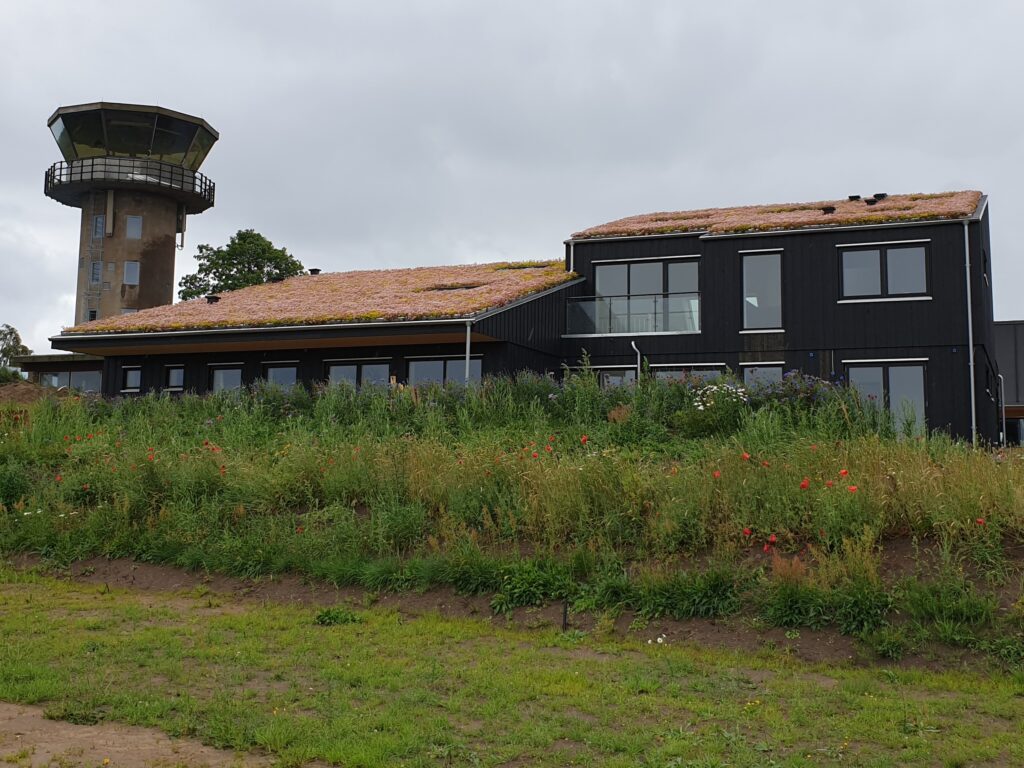
In 2019, the Mageløse residential community was established north of Copenhagen on part of the former Værløse Air Base. Thirty houses are supplied with heat extracted from a pump-and-treat remediation well. A thermonet connects the heat exchanger at the well with heat pumps installed in each connected house. The system provides residents with heating at very low costs.
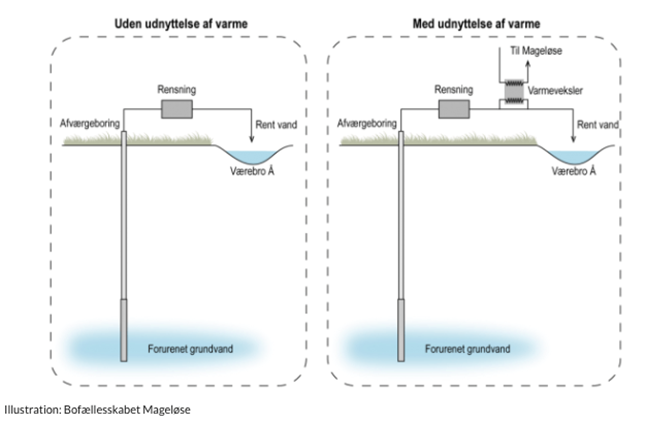
The remediation well had been established earlier by Søndersø Waterworks to prevent drinking water extraction from being affected by pollutants seeping from former military activities at Værløse Air Base. The well and the treatment plant is located at the former air waterworks. After treatment, the groundwater is discharged to a nearby watercourse.
The future residents of Mageløse came up with the idea to use heat from the pumped groundwater. Several residents have engineering backgrounds.
Actors
The community, formally the property owners’ association, took on the role as developer for the thermonet system. The Mageløse community has 29 homes and a common house. Flemming Davidsen served as their advisor.
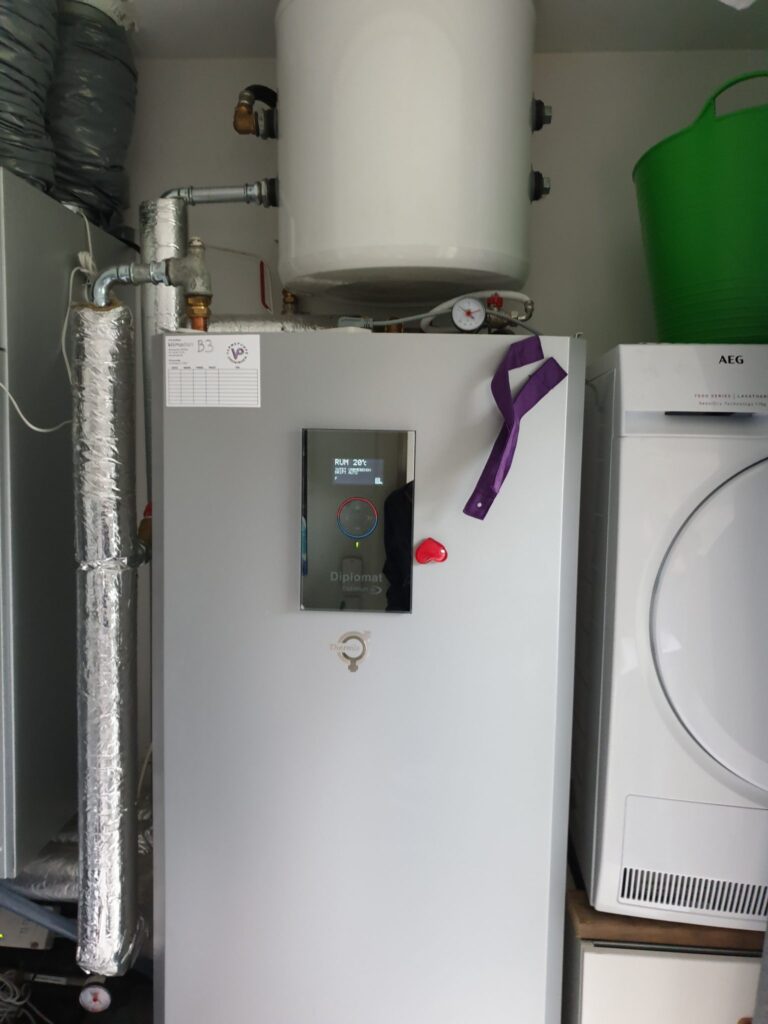
Klimadan designed the system and supplied Thermia heat pumps, the heat exchanger, and the thermonet itself.
The solution
The 29 homes are divided into 14 semi-detached houses and one detached house, ranging from 90-180 m². The common house is 350 m². The owner’s association was founded in March 2016. Site preparation and construction began in 2018. The thermonet solution became operational in November 2019.
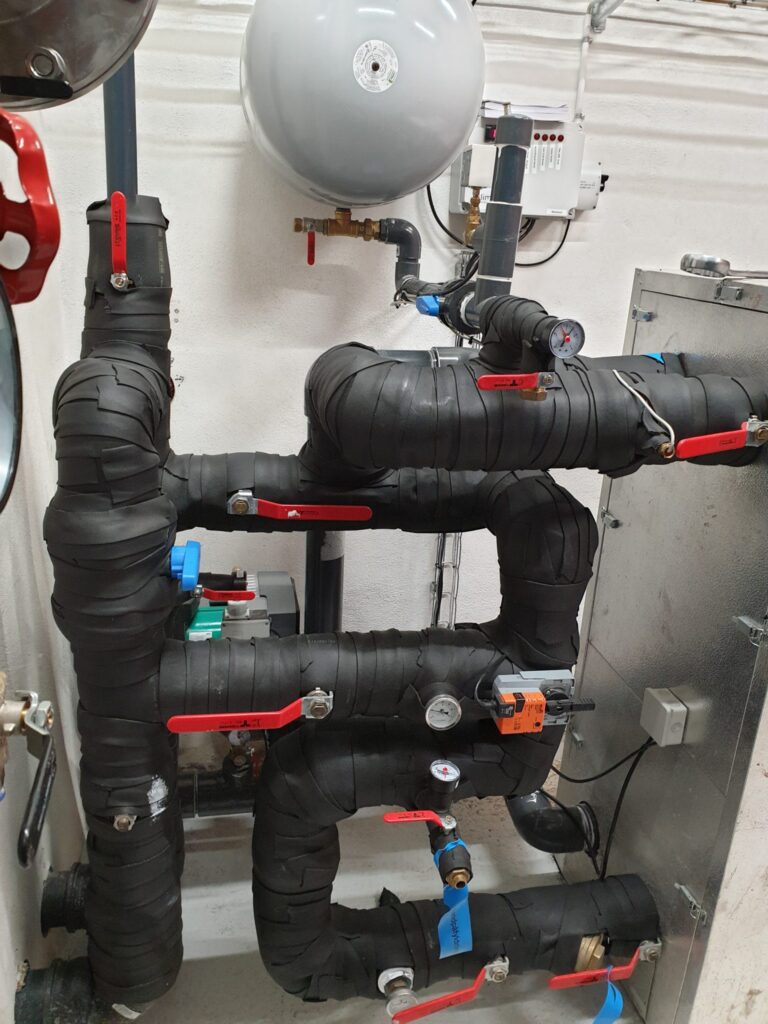
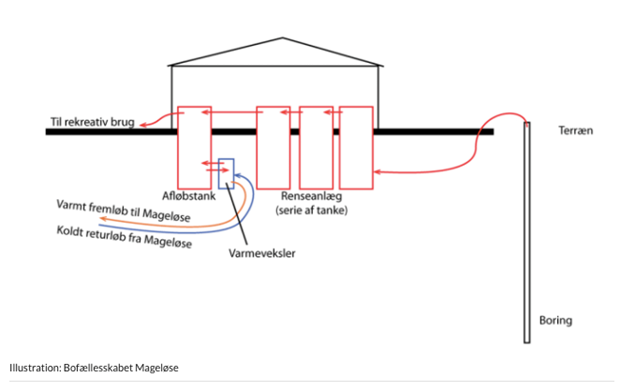
Heat is extracted from the remediation well via a large heat exchanger located after the treatment plant. The two-pipe thermonet is 2 × 200 meters long. Connected houses use 6 kW Thermia Diplomat on/off heat pumps with buffer tanks.
The thermonet’s supply temperature is approximately 10°C. Return flow from the heat pumps is approximately 2°C.
As shown in the following diagrams, the establishment of the heat exchanger is simple and technically uncomplicated.
Before choosing the remediation well as heat source, the residents investigated several other options:
- Horizontal ground-source heat loops: Due to the sandy soil in the area, 10 km of ground loops would have been required.
- Individual air-to-water heat pumps: This option was rejected to avoid noise from outdoor units (approximately 400 other new homes on the former air base have air-to-water heat pumps).
- One shared heat pump, or one heat pump per six houses, or one heat pump per four houses: These solutions were rejected due to greater complexity. Only one supplier was interested in providing a quote, and the price was high.
- Utilization of approximately 15°C warm wastewater from the nearby Måløv Wastewater Treatment Plant: This option was rejected because that treatment plant will close within 10 years.
At some point in the future, the remediation well will have fulfilled its purpose and will be closed. The expected time horizon is very long, as the remediation well protects significant drinking water sources from contamination.
Economics
Total investment for the system (heat exchanger, thermonet, and heat pumps) was DKK 2.75 million, equivalent to DKK 95,000 per home (2019 prices). The heat exchanger and thermonet were established as part of the site preparation. The property owners’ association owns the heat exchanger and the thermonet, while individual homeowners own their heat pumps. In this way, homeowners were able to finance the whole system through mortgages on their individual properties.
Heat pump electricity consumption is estimated at approximately 1,500 kWh/year for an average 135 m² house. Based on average 2024 electricity prices (excluding electricity tax), annual heating costs are approximately DKK 3,000 – substantially lower than gas heating or individual air-to-water heat pumps.
The remediation pumping delivers 35 m³ of groundwater per hour. Available thermal energy is three times higher than peak load demand, meaning capacity exists to connect significantly more homes without additional heat extraction.
Key experiences
- Being the developer, the community found that the heat pump industry is generally not geared toward developing and establishing collective solutions as genuine alternatives to individual standard solutions.
- The economic benefit of a thermonet solution comes from low operating costs over the system’s lifetime. Capital costs will be comparable to or higher than alternative solutions. This can make it difficult to involve property developers who focus on capital costs rather than total cost of ownership.
- Connection of the thermonet’s supply and return lines to heat pumps should be a simple task. Nevertheless, there were several examples of incorrect installation. This type of problem can be prevented through increased supervision during installation and clear marking of supply and return on the thermonet’s service lines.
- After commissioning, the community concluded that the solution with 30 decentralized heat pumps was preferable, as it is technically less complex than solutions with fewer, larger shared heat pumps.
More information about the project
magelose.dk – The community’s official website