
In Oberndorf, a district of the southern German town of Rottenburg, a new residential quarter is supplied with geothermal heating and optional cooling via a thermonet at a minimal upfront cost, lower than the cost of an air source heat pump. The thermal energy is collected from approximately 14,000 m² of horizontal ground loops ploughed into neighbouring farmland.
The thermonet – an uninsulated network of PE-pipes – distributes the low-temperature geothermal energy to decentralised heat pumps in up to 130 new homes. The municipal utility, Stadtwerke Rottenburg, owns and operates the entire system from the ground loops through the thermonet to the heat pumps in each home, offering residents a full-service supply model where everything is taken care of.
Background
Rottenburg am Neckar is a town of approximately 43,000 inhabitants in the Tübingen district of Baden-Württemberg, southern Germany. The municipal council adopted the local plan for the Engwiesen II residential area in 2019. Site preparation began in June 2022. As of early 2025, building plots were still being sold, with a mandatory two-year building start obligation from purchase. The first houses were built and connected to the thermonet in early 2026.
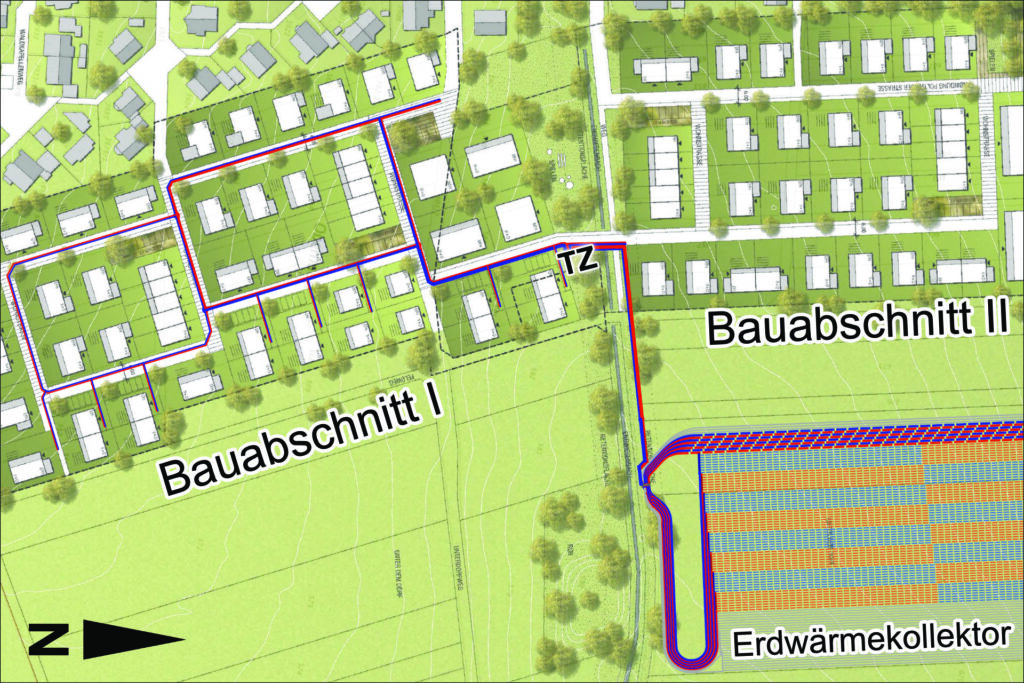
The project builds on Stadtwerke Rottenburg’s earlier experience with a smaller thermonet in the Öchsner II development (2020–2022) in Rottenburg-Ergenzingen, where a similar approach was successfully implemented. Engwiesen II uses a similar design on a larger scale.
The solution
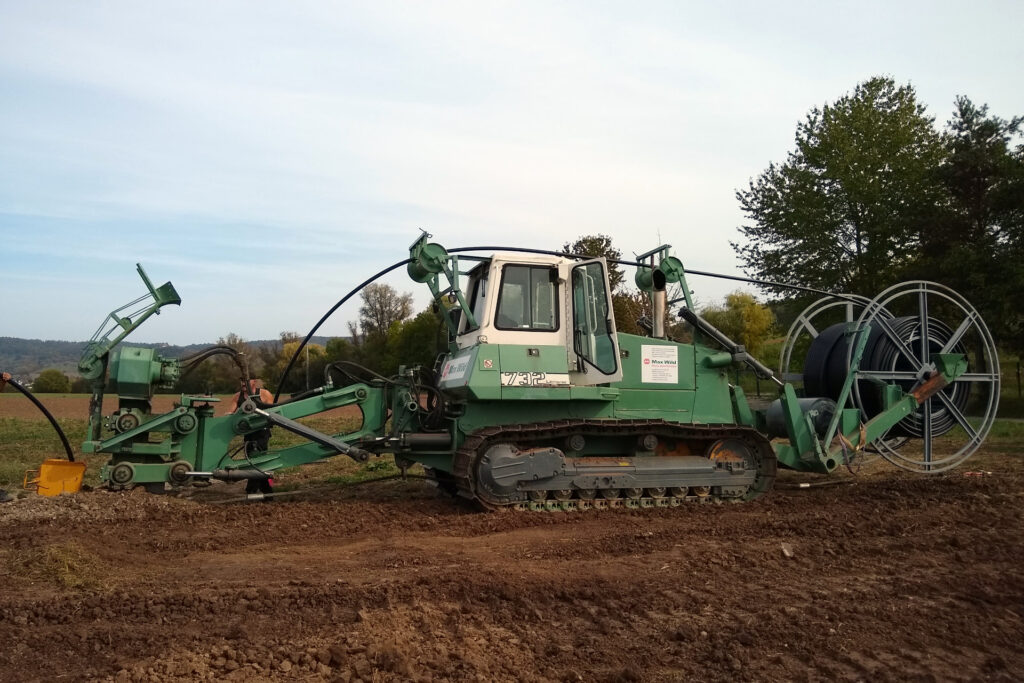
Thermal energy collection. On neighbouring agricultural land, approximately 14,000 m² of horizontal ground loops have been installed at a depth of 1.2 to 1.4 metres. The pipes were ploughed into the soil, a method that minimises disturbance to the land. A brine circulates through the loops and the thermonet, absorbing thermal energy from the ground. After installation, the land can continue to be used for agriculture.
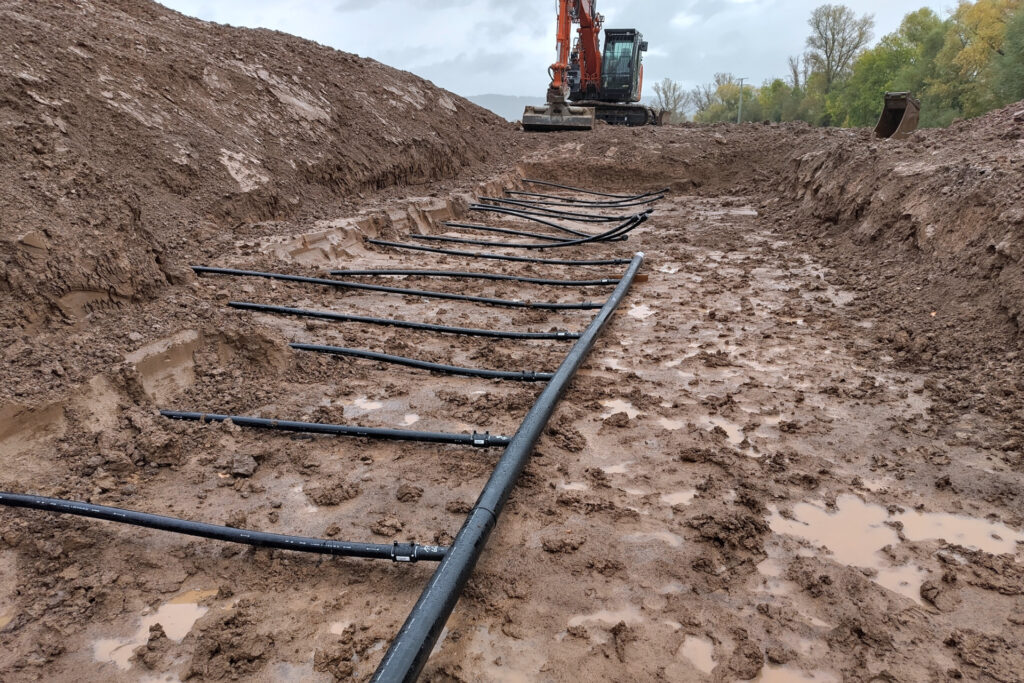
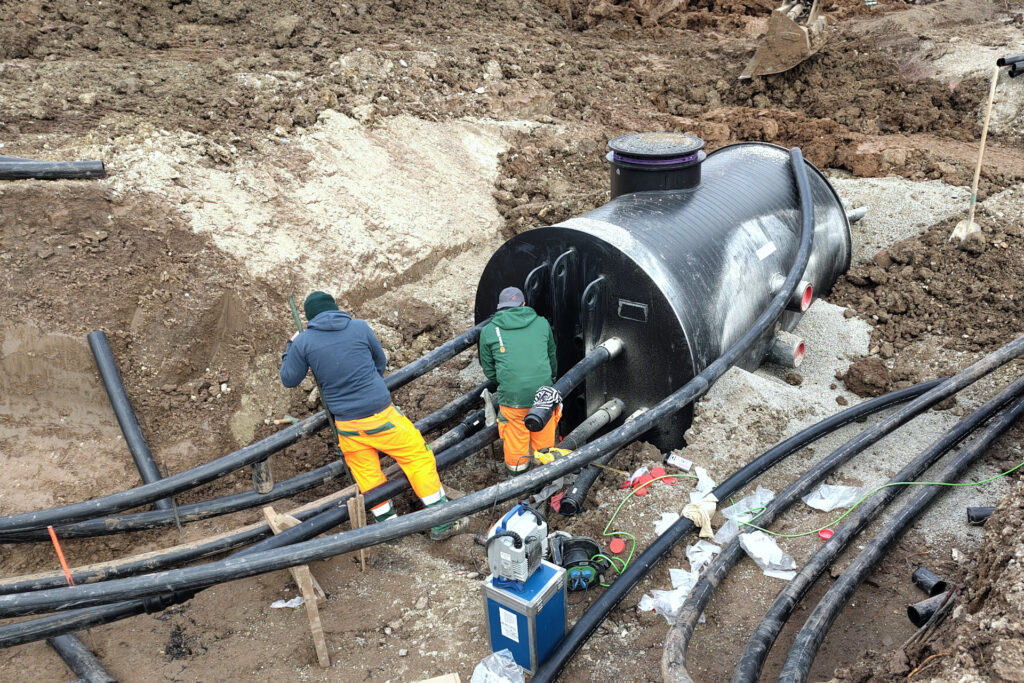
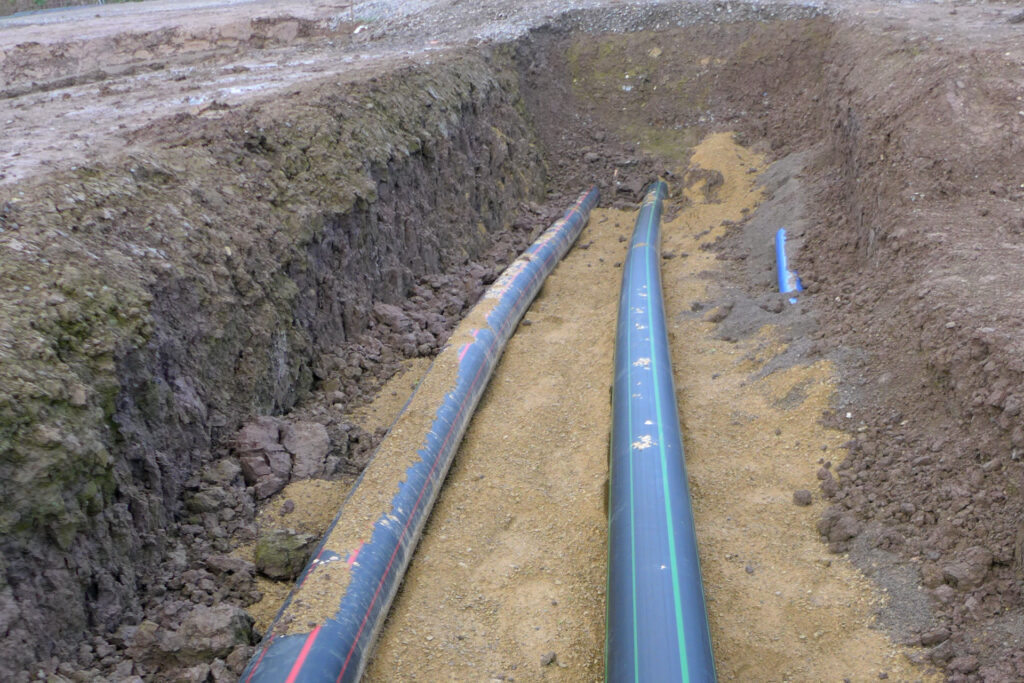
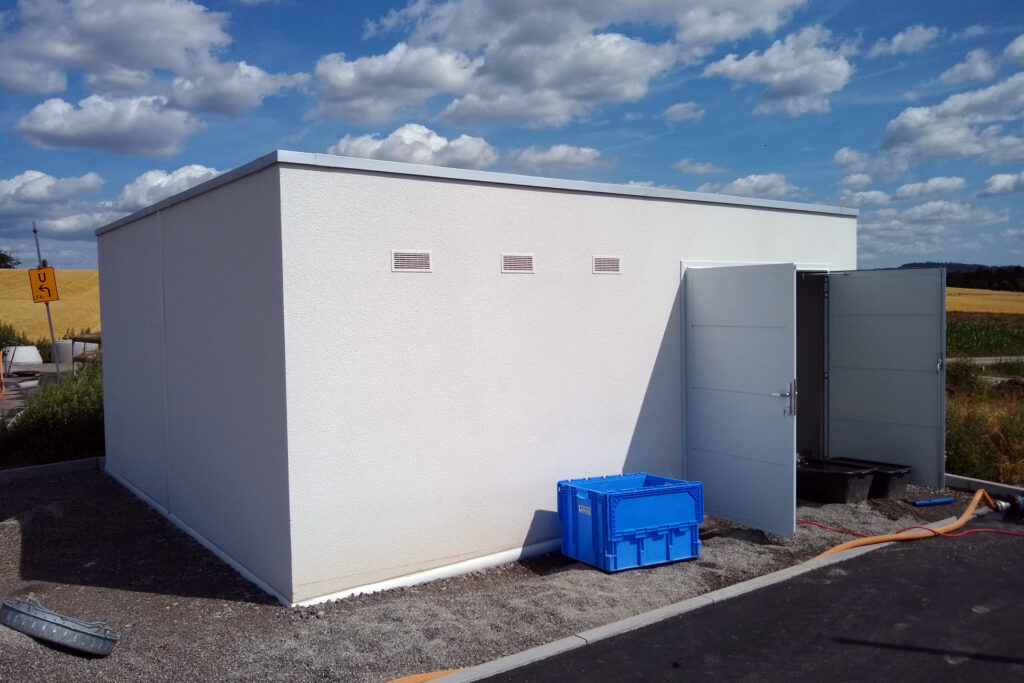
The thermonet. Made from uninsulated PE pipes, the thermonet runs beneath the streets of the development with service lines to each house, transporting thermal energy from the geothermal uptake to the decentralised heat pumps. Circulation is driven by the small integrated pumps in each dwelling’s heat pump, with no central pumping station. A service building houses the pressure maintenance system and network monitoring equipment. Thermal energy is distributed at near-ground temperature, which means that the thermonet contributes to the geothermal energy uptake in line with what has been scientifically documented elsewhere (1).
Heat pumps. A ground-source heat pump in each house raises the temperature to the level required for space heating and domestic hot water. Based on the system’s design, COP values of approximately 4 to 5 are expected. The Stadtwerke supplies the heat pumps with 100% green electricity.
Scale and phasing
The development is planned in two construction phases. Phase 1 comprises an estimated 80 dwellings across a mix of detached houses, semi-detached houses, terraced houses, and multifamily buildings. Phase 2 adds another 50 dwellings, bringing the total to approximately 130. The thermonet infrastructure was installed as part of the initial site preparation, ahead of house construction. Phase 1 was completed in July 2023. As of 2026, phase 2 has not been initiated.
The system’s total heating capacity is 410 kW, with projected annual heat delivery of 610 MWh.
Cooling
Passive cooling is offered as an optional feature. In summer, the thermonet carries near-ground temperature for use in underfloor pipes. This approach requires minimal use of electricity for cooling as only the circulation pumps operate.
Ownership and supply model
Stadtwerke Rottenburg owns and operates the entire supply system – the ground loops, the thermonet and the individual heat pumps. Residents pay a one-time connection fee and ongoing heating costs consisting of a fixed annual base charge and a consumption-based energy charge. The Stadtwerke manages all maintenance, servicing, and replacement of equipment as a full-service package (German: “Rundum-Sorglos-Paket”).
Connection to and use of the thermonet is a condition of purchasing a building plot, which the city of Rottenburg sells to prospective homeowners. This ensures full network utilisation from the outset, which is essential for the economic viability of the system. The initial contract term is 10 years, after which it renews.
Economics
The Stadtwerke has stated that the heating costs are independent of oil and gas price developments and that the system is competitive with conventional heating solutions.
Actors
Stadtwerke Rottenburg am Neckar GmbH owns and operates the ground loops, the thermonet and the heat pumps, and supplies heating to residents.
Stadt Rottenburg am Neckar, the municipality, owns the development site and sells building plots to prospective homeowners.
tewag GmbH was responsible for the geothermal specialist planning of the ground loops and thermonet, including hydraulic design, tender preparation, and construction supervision. Project management and design was led by Dr. David Kuntz, who has since co-founded GeoAlto GmbH in Rottenburg, which presents the project among its references.
Herbert Germey GmbH carried out civil engineering and infrastructure planning (thermonet, water, wastewater, electricity, roadworks).
Gottlob Brodbeck GmbH & Co. KG constructed roads, sewer ducts, pipelines (including the thermonet) and common infrastructure.
Waterkotte supplied the ground-source heat pumps.
Max Wild GmbH installed the horizontal ground loops by ploughing them into the soil.
FRANK GmbH supplied the underground PE-manifold chamber in which the ground loops are connected to the thermonet.
WKT Westfälische Kunststofftechnik GmbH supplied the pipes for the thermonet.
Polytech Industrie Kft. (now Teraplast) supplied the ground loop pipes.
More information
Stadtwerke Rottenburg – Kalte Nahwärme information page: https://www.sw-rottenburg.de/waerme/kalte-nahwaerme.html
GeoAlto GmbH – Engwiesen II project page: https://www.geoalto.de/de/case-studies/engwiesen2
Media coverage
July 2022 – Herbert Germey GmbH: Ground-breaking ceremony for Engwiesen II site preparation. https://www.germey.de/2022/07/07/spatenstich-bg-engwiesen-in-rottenburg-a-n-oberndorf/
References
(1) A thermonet has been shown to gain heat, in effect acting itself as a thermal energy uptake, cf. Marwan Abugabbara: District heating and cooling systems transition: Evaluation of current challenges and future possibilities (pdf-side 78-79, printed page 50-51)